
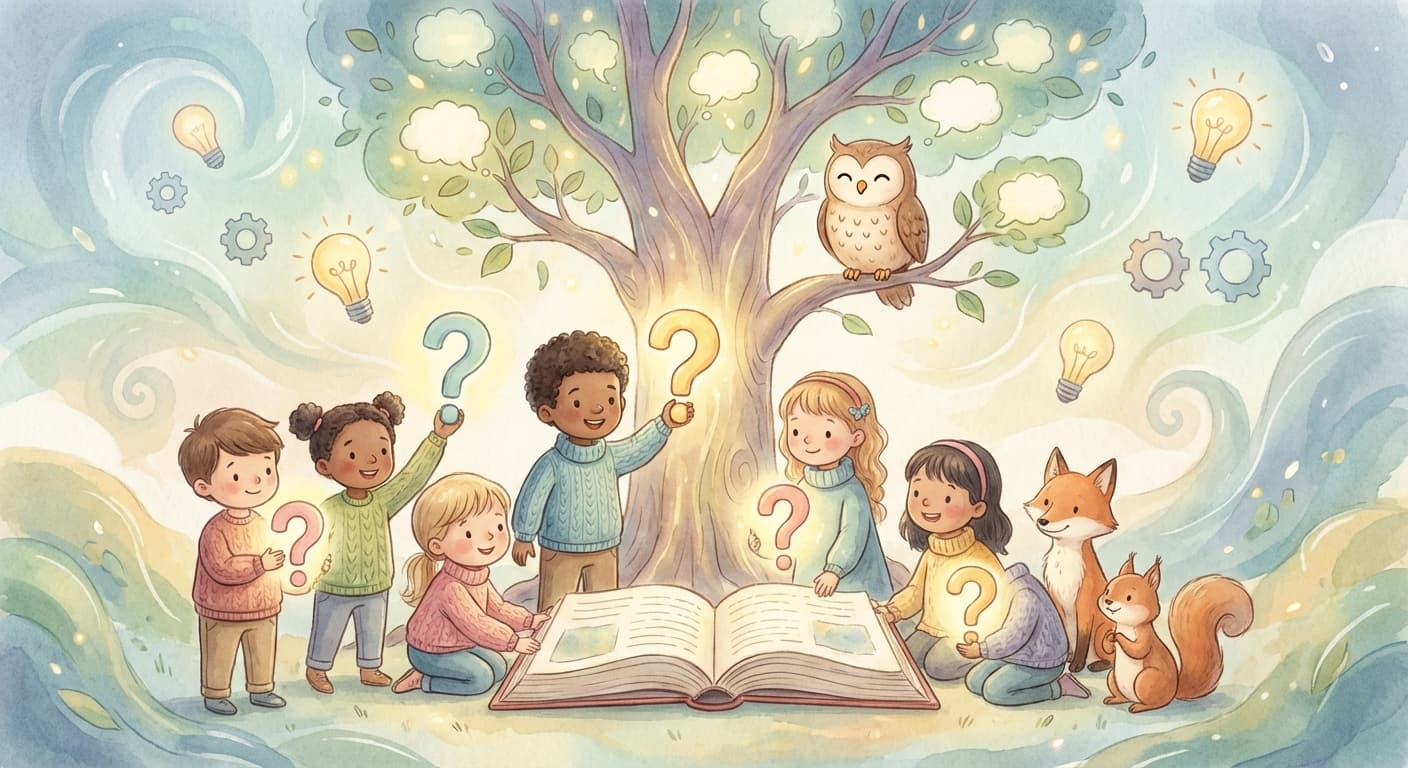
The Curious Child: Why “WHY?” Might Be the Most Important Word in Learning
“Why is the sky blue?”
“Why do I have to eat vegetables?”
“Why can't we have ice cream for breakfast?”
If you've ever spent an entire car ride answering questions from a tiny human, congratulations! You've attended one of the most interactive learning sessions of your life. No textbooks required. Just a curious child and an adult desperately trying to remember their science lessons!
But here's something wonderful: behind every little “why” is a mind trying to understand the world.
And that is where the magic of learning begins.
1. Little Questions, Big Discoveries
Children are natural explorers. Give them a cardboard box, and they'll turn it into a spaceship. Show them a puddle, and they'll wonder where the water came from. Introduce a butterfly, and suddenly you're discussing wings, colours, flowers, and the mysteries of nature.
Their curiosity doesn't follow a timetable. It doesn't wait for Monday's science class.
It happens everywhere!
Instead of rushing to provide an answer every time, try asking, “What do YOU think?”
You might be surprised by what comes next.
Even when their answers are hilariously wrong, they're practising observation, imagination, and reasoning. Learning isn't always about getting the answer right on the first try. Sometimes, it's about enjoying the journey towards it.
2. Turn Everyday Life into a Classroom
Who said learning needs a blackboard?
Your kitchen can become a science laboratory. A grocery shopping trip can turn into a mathematics lesson. A walk in the park can become an exciting exploration of nature.
Here are three simple ideas to try at home:
🥣 The Kitchen Scientist
Ask your child what happens when ice melts. Let them observe it, make a prediction, and explain what they notice. Suddenly, science has become a hands-on adventure!
🛒 The Little Shopkeeper
Give your child a small shopping budget and ask them to calculate the cost of a few items. They'll practise mathematics while learning about money and making decisions.
🌱 The Backyard Detective
Find a plant, observe its leaves, and discuss what it needs to grow. Encourage your child to draw what they see and revisit it after a few days.
The best part? You don't need expensive toys or fancy equipment. Sometimes, the simplest experiences create the most memorable lessons.
3. Let Children Make Mistakes (Yes, Really!)
Imagine building a tower of blocks. Your child carefully stacks one block on another, adds five more, and proudly declares it the tallest tower in the world.
Then… CRASH!
The tower falls.
You could immediately show them how to build it correctly. Or you could ask, “What do you think made it fall?”
One response ends the experiment. The other begins a new one.
When children are allowed to try, fail, rethink, and try again, they learn persistence and problem-solving. They discover that mistakes aren't embarrassing little disasters. They're clues that help us figure things out.
Of course, nobody enjoys watching their masterpiece collapse. A little disappointment is perfectly normal. But with encouragement, that disappointment can become the motivation to build an even better tower.
And perhaps a tower with a wider base this time!
4. Curiosity Needs More Than Correct Answers
We often celebrate children for getting the right answer. Good marks, completed worksheets, and correct spellings deserve recognition.
But what about the child who asks an unexpected question? The one who suggests a completely different solution? The one who wants to explore a topic long after the lesson has ended?
These moments matter, too.
Children need opportunities to ask questions, express ideas, discuss different perspectives, and connect what they learn with the world around them.
This is why learning should go beyond memorising information. It should also help children develop creativity, communication, critical thinking, and confidence.
At Golden Sparrow, we believe education should nurture the curious mind, not simply fill it with facts. Through activity-based learning, practical experiences, and life skills, children get opportunities to explore concepts and discover their own potential.
Because knowing the answer is wonderful. Understanding how to find the answer is even better!
5. A Small Challenge for Parents
Here's a little experiment for this week.
Whenever your child asks you a question, resist the urge to answer immediately. Instead, try one of these:
“What do you think?”
“How could we find out?”
“Can you show me what you mean?”
“What would happen if we tried something different?”
You don't have to know everything. In fact, saying “I don't know. Let's find out together!” can be a wonderful way to show children that learning never really stops.
And don't worry if you occasionally run out of answers. Even the most patient parent deserves a little break from the endless “whys”!
The Big Takeaway: Keep the Questions Coming!
Childhood is full of little wonders. A shadow on the wall, a snail after the rain, a question about the moon — each can become the beginning of a new discovery.
Our job isn't to turn every moment into a formal lesson. It's to create an environment where children feel comfortable exploring, wondering, experimenting, and expressing themselves.
So the next time your child asks, “But WHY?”, take a breath, smile, and get curious together.
Who knows? You might learn something new, too.
At Golden Sparrow, we believe every curious mind deserves the freedom to explore, question, and grow. Because today's little questions can inspire tomorrow's big ideas.
Happy exploring, little sparrows! 🐦